Pico della Mirandola on Trial by Brian P. Copenhaver
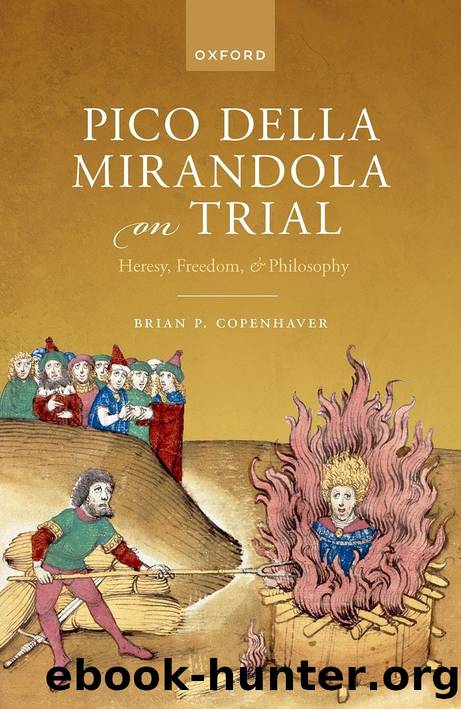
Author:Brian P. Copenhaver [Copenhaver, Brian P.]
Language: eng
Format: epub
ISBN: 9780192674166
Publisher: OUP Oxford
Published: 2022-04-25T00:00:00+00:00
Pico della Mirandola on Trial: Heresy, Freedom, and Philosophy. Brian P. Copenhaver, Oxford University Press. © Brian P. Copenhaver 2022. DOI: 10.1093/oso/9780192858375.003.0004
1 John 1:1â14; Denziger, Hoping and Hünermann (2012), pp. 19â27 (10â30, esp. 30).
2 Daley (2018) is a recent study of patristic Christology; for John of Damascus, see Louth (2002).
3 Louth (2002), pp. 3â37.
4 Rosemann (2004) is a recent introduction to Peter Lombard; Colish (1994) is comprehensive and detailed. For canon law in the twelfth century and before, see Brundage (1995), pp. 5â69.
5 Peter Lombard, Sent. 3.pr.; (1971â81) is the modern edition, translated in (2007â10) by Giulio Silano; translations here are mine.
6 Peter Lombard, Sent. 3.2.1; Colish (1994), pp. 417â21; John of Damascus, De fide 3.2, 4, 6â7; (1958), the English version by Frederic Chase, translates all three parts of the Fountain of Knowledge. The Latin natura in medieval theology could be either universal (nU), as in âhuman nature,â or particular (nP), as in âa human nature,â or âthe human nature.â Two humans, Plato and Socrates, share the human nU, but Platoâs nP doesnât belong to Socrates, and vice versa. Medieval theologians sometimes treated nP and persona as synonyms; they also closely identified nPnaturae with metaphysical supposita. They classified the nU shared by Plato and Socrates as a secondary substance and each philosopher, with his own nP, as a primary substance: see Aquinas, ST 3.2.2; SS 3.6.1.2; and Chapter 2.3â5 of this book.
7 Peter Lombard, Sent. 3.1.2, 12.4.
8 Peter Lombard, Sent. 3.12.2.
9 Peter Lombard, Sent. 3.2.1.2, citing John of Damascus, De fide 3.4; ibid., 3.2.1.4, citing 3.6; ibid., 3.5.1.12, citing 3.6; 3; ibid., 6.3.4, citing 3.6.
10 Peter Lombard, Sent. 3.6.3.4; Verg. App. mor. 102; cf. Cic. Off. 1.56; Heracl. frg. B10 (DK); also Louth (2002), pp. 3â14.
11 John of Damascus, De fide 1.8 (Chase, pp. 186â7), 1.14 (Chase, p. 202); Twombly (2015) pp. 8â12, 44â5.
12 John of Damascus, De fide 3.5 (Chase, p. 278, modified); Twombly (2015) p. 47.
13 John of Damascus, De fide 1.8 (cf. Chase, p. 187); Dial. 65.98â109 (cf. Chase, pp. 102â3).
14 OâCarroll (1987), pp. 68â70; Louth (2002), p. 104; Twombly (2015) pp. 82â3, 104.
15 Plot. 1.8.2; Dion. Areop. Div. nom. 704D.
16 Aquinas, SS 3.2.
17 Aquinas, SS 3.2.1.1.1.
18 Aquinas, ST 3.4.1; Kennedy (1989), (1990).
19 Cabrol (1900â07), 5.13.
20 Pico, Q4.1â3, 7, 10, 25â7, 29â30, 33, 35â7; (Apo. pp. 41â2, 45â7; Afr., pp. 134â8, 144â52): for Q4, Q8, Q9 and Q10, I cite my translations, by paragraph, at the ends of Chapters 3, 4 and 5 of this book; see also Cabrol (1900â08), 5.12â26, esp. 12. Except for Q4.7 and 10, in the excerpt from Henry of Ghent, all the suppo- words in Q4 are in passages written by Pico himself; hence, the presentation of metaphysical suppo- words in this Question is his own. For the deep background of suppo- words and related terminology in Christian theology, see sections 6â8 of Chapter 2 of this book.
21 Pico, Con. p. 2 (Bnd. p. 10).
22 Pico, Con. p. 3 (Bnd. p. 12).
23 Pico, Con. p. 42 (Bnd. pp. 90â1).
24 Pico (1995), p.
Download
This site does not store any files on its server. We only index and link to content provided by other sites. Please contact the content providers to delete copyright contents if any and email us, we'll remove relevant links or contents immediately.
| Anthropology | Archaeology |
| Philosophy | Politics & Government |
| Social Sciences | Sociology |
| Women's Studies |
Born to Run: by Christopher McDougall(7132)
The Leavers by Lisa Ko(6952)
iGen by Jean M. Twenge(5419)
Sapiens by Yuval Noah Harari(5375)
Spare by Prince Harry The Duke of Sussex(5202)
The Kite Runner by Khaled Hosseini(5188)
Machine Learning at Scale with H2O by Gregory Keys | David Whiting(4317)
Bullshit Jobs by David Graeber(4197)
Never by Ken Follett(3963)
Goodbye Paradise(3813)
Livewired by David Eagleman(3778)
Fairy Tale by Stephen King(3403)
A Dictionary of Sociology by Unknown(3088)
Harry Potter 4 - Harry Potter and The Goblet of Fire by J.K.Rowling(3077)
The Social Psychology of Inequality by Unknown(3039)
The Club by A.L. Brooks(2930)
Will by Will Smith(2930)
0041152001443424520 .pdf by Unknown(2850)
People of the Earth: An Introduction to World Prehistory by Dr. Brian Fagan & Nadia Durrani(2740)
